
Drinking Cultures of the Nineteenth Century
Intoxication and Gender Roles
Back then, like now, alcohol consumption was deeply intertwined with questions of respectability, class, and gender roles Until the mid-1800s, both men and women consumed alcohol in shared spaces – cold punch, especially, was a post-dinner drink for everyone. But by mid-1800s, there was the emergence of “separate spheres” – men in public life, women confined to private, household life. Women's alcohol consumption became more morally coded (Think of Thea saying “no no I never drink such things" though Hedda does drink the punch).
Although Lovborg’s alcoholism is a subject of gossip and censure in the play, the spectacle of men drinking in itself is expected and rewarded (as in Brack’s party). There was a culture of "brotherhood" around drinking. "Brorskålar" (literally ‘brother toasts’) was a frat-boy type of scenario, as Hanne Enefalk describes: "A man of higher rank proposed the toast to a man of subordinate status. After having drunk from their glasses, the two men could now drop the titles and address each other as ‘brother’. To drink a brorskål with somebody from the working classes was unthinkable, and it goes without saying that women were excluded."
But with the rise of the Temperance Movement, i.e. alcohol prohibition, in Norway and all over Europe and America, the association of alcoholism with immorality became stronger. Alcohol consumption began to be viewed as a synonym for insanity - a mental and physical problem. According to the president of the British Society for the Study of Inebriety, Norman Kerr, inebriety was "a disease of the nervous system allied to insanity” and an “abnormal condition, in which morbid cravings and impulses to intoxication are apt to be developed in such force as to overpower the moral resistance and control." Alcohol misuse was now regarded as a moral problem of self-control, and especially antithetical to middle-class values and a threat to domestic bliss. There is a circular logic here - a lack of self-control causes one to drink excessively and drinking excessively further causes a lack of self-control.
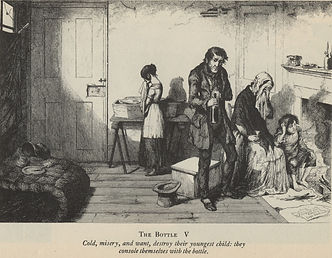
British artist and temperance activist George Cruikshank illustrates this idea very dramatically in a series of sequential paintings called "The Bottle" (1847)

Smoking was also gender-segregated. It was taboo for women of higher classes to smoke, and cigarettes were typically associated as a habit of lower class women, or with renegade women who resisted control. For example, consider this description, written by Lynn Linton in 1891, of a typical "wild woman": She smokes after dinner with the men, in railway carriages; in public rooms - when she is allowed. She thinks she is thereby vindicating her independence and honouring her emancipated womanhood.”
Sources:
-
Enefalk, Hanna. "Alcohol and femininity in Sweden c. 1830–1922: An investigation of the emergence of separate drinking standards for men and women." Substance Use & Misuse 50.6 (2015): 736-746.
-
Enefalk, Hanna. "Alcohol and respectability: A case study of central Sweden circa 1800–1850." Scandinavian Journal of History 38.3 (2013): 296-317.
-
https://www.bivrost.com/when-norwegians-went-dry-part-1-ancient-moonshining
-
Johan Edman, Temperance and Modernity: Alcohol Consumption as a Collective Problem, 1885–1913, Journal of Social History, Volume 49, Issue 1, Fall 2015, Pages 20–52.